Although Italy is often considered primarily a producer of red wines, it is nonetheless interesting for its sparkling white wines, including Franciacorta (the Italian version of champagne), Prosecco (another sparkling wine), and dry whites. Italy's wine-growing area, covering 675,135 hectares, is remarkable for its great terroirs, numerous typical climates, and indigenous grape varieties, without ruling out the use of the great Bordeaux grape varieties, and rightly rivals the best wines in the world, including Bordeaux.
When did Italian viticulture begin in relation to the birth of vine cultivation among the Sumerians (6,000 years ago) and then among the Egyptians (5,000 to 3,000 years ago)? In fact, the first appearances of Italian vineyards in history (in practical and economic terms) date back to the Etruscan civilization, the ancestors of the ancient Romans. But before the Romans developed the wine economy more fully, it should be remembered that it was the Greeks who largely laid the foundations for the emancipation of vines throughout the “Mare Nostrum” (the Mediterranean basin). Under Greek influence, Italy came to be known as Oenotria, meaning “the land of wine.” At that time, vineyards developed and spread throughout Italy.
But gradually, over the centuries of our era, winemaking techniques have slowly stagnated, while French viticulture and its techniques have made more noticeable and demonstrative advances. However, from the end of the 16th century and the beginning of the 17th century, under the influence of two powerful Italian aristocratic wine families, Antinori and Frescobaldi—who still hold a prominent place in the international reputation of Italian wines today—Italian viticulture took off, driven by these two great families. However, in the 20th century, marked by the exile of Italians in the face of the rise of fascism in the early 1920s under Mussolini, Italian wines fell into crisis. It was not until the creation of the EEC (European Economic Community) under the impetus of Frenchman Jean Monnet with the Treaty of Rome in 1957, as well as the relaxation of Italian legislation, that Italian wines achieved unprecedented levels of reputation in the 1990s, to the point of shining internationally, as is still the case today. A reputation born in the late 1970s with Super Tuscans, Tuscan wines made from Bordeaux grape varieties alone or complemented by the Italian Tuscan grape variety, Sangiovese. In other words, prestigious red wines that do not comply with the strict specifications of the DOC and DOCG appellations of Tuscany. The value and appeal of these prestigious wines among serious wine lovers became apparent in the 1980s and grew in the 1990s and 2000s. Today, despite a less pronounced trend, these wines are still the object of desire for discerning collectors and tasters.
Did you know? Italy has the largest organic vineyard in the world, with more than 100,000 hectares of organic vines (107,143 hectares to be exact) compared to 500,000 hectares of organic farming worldwide (according to the Italian Ministry of Agriculture), compared to 7 million hectares of vines for vineyards worldwide. In other words, organic viticulture in Italy accounts for nearly 19% of its vineyards (of the total hectares of vines in Italy) and is practiced by 18,000 Italian winegrowers. In Europe, Italy is not only the leader in organic vine cultivation, but also ahead of other European vineyards in terms of organic wine exports. It should be noted that its main markets for organic wines are mainly France and Germany.
As for the growth of organic wine production in Italy, while organic acreage has doubled worldwide, Italian vineyards cultivated organically have increased by 109%. The strongest growth in organic farming has been in northern Italy (22.8% of vineyards are organic), while in the south and center, organic farming accounts for 25.5% and 29.2% of vineyards respectively (particularly in Sicily and Sardinia).
Italian wines have a unique personality and are truly one-of-a-kind when they are single-varietal (such as Nebbiolo and Barbera in Piedmont and Sangiovese in Tuscany). Many Italian wines, mainly in Tuscany, have also opted for blends with highly successful Bordeaux grape varieties such as Cabernet Sauvignon, Cabernet Franc, Merlot, and even Petit Verdot. These elegant and refined blends come to life in IGT Toscana wines, notably embodied by famous Super Tuscans such as Sassicaia, Ornellaia, Masseto, and Tignanello.
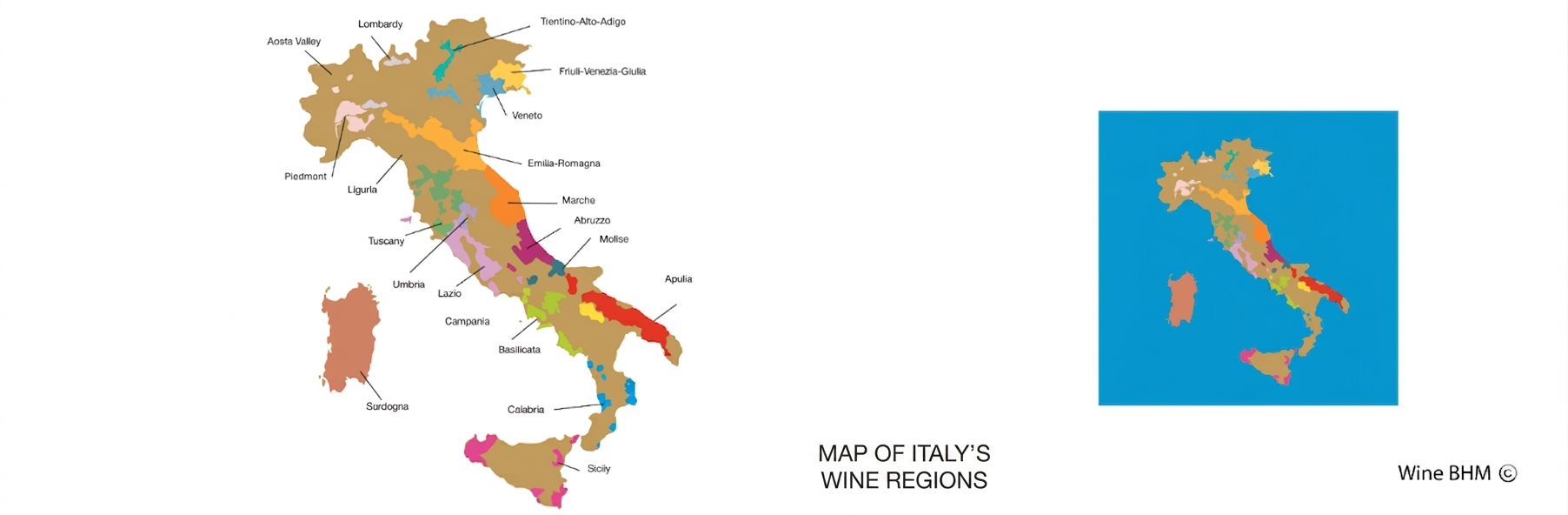
Italy's vineyards cover 675,135 hectares spread across the entire country and are divided into twenty wine-growing regions. However, the main regions most often mentioned internationally are Piedmont in the north, Veneto, Lombardy, and Alto Adige in the northeast, Tuscany in the south, Puglia in the southeast, Sicily in the southwest, and Emilia-Romagna in the east. Italy has no fewer than 77 DOCG (the equivalent of French appellations d'origine contrôlée), 332 DOC and 156 IGT.
DOCG | DOC | IGT |
|---|---|---|
Asti e Moscato d’Asti | Barbera d’Alba | Vino d’Italia |
Barbera d’Asti | Dolcetto d’Alba | |
Barolo | Langhe | |
Barbaresco | Barbera del Monferrato |
View all appellations of Piedmont

Join the selection of producers on the platform.
Join the network*Featured listings are reserved for Pro Premium members, subject to terms and conditions.