Israel is one of the world's oldest wine-growing regions and one of the most surprising. With approximately 6,500 hectares of vineyards stretching from the arid Negev in the south to the Upper Galilee and the Golan Heights in the north, the country produces more than 40 million bottles a year, nearly 20% of which are exported. It was biblical viticulture that gave birth to wine here, but it was the quality revolution of the 1980s and 1990s, driven by a new generation of winemakers trained in Australia, California, and France, that propelled Israel onto the world stage. Less than 15% of production is now destined for liturgical wines. More than 350 wineries, at altitudes of up to 1,200 meters, five official regions, and a striking diversity of terroirs for a country the size of Belgium.
Winegrowing in Israel dates back to biblical antiquity, the vine is among the seven blessed species mentioned in Deuteronomy. In Roman times, wines from Judea were exported to Rome, with the winemaker's name engraved on the amphora. The rise of Islam in the 7th century brought production to a halt for over a thousand years. The renaissance began in 1870 with the founding of the first Jewish agricultural college, Mikveh Israel, which offered instruction in viticulture. In 1882, Baron Edmond de Rothschild, owner of Château Lafite-Rothschild in Bordeaux, financed the creation of the Carmel Winery in Rishon LeZion and Zikhron Ya'akov, the oldest Israeli winery still in operation. The quality revolution took off in the 1980s with the arrival of winemakers trained in California, Australia, and France. In 1983, Golan Heights Winery was founded and revolutionized quality standards. In 1989, Margalit Winery ushered in the era of boutique wineries. In the 1990s, Domaine du Castel and Golan Heights Winery won their first international awards. Today, Israel has more than 350 active wineries.
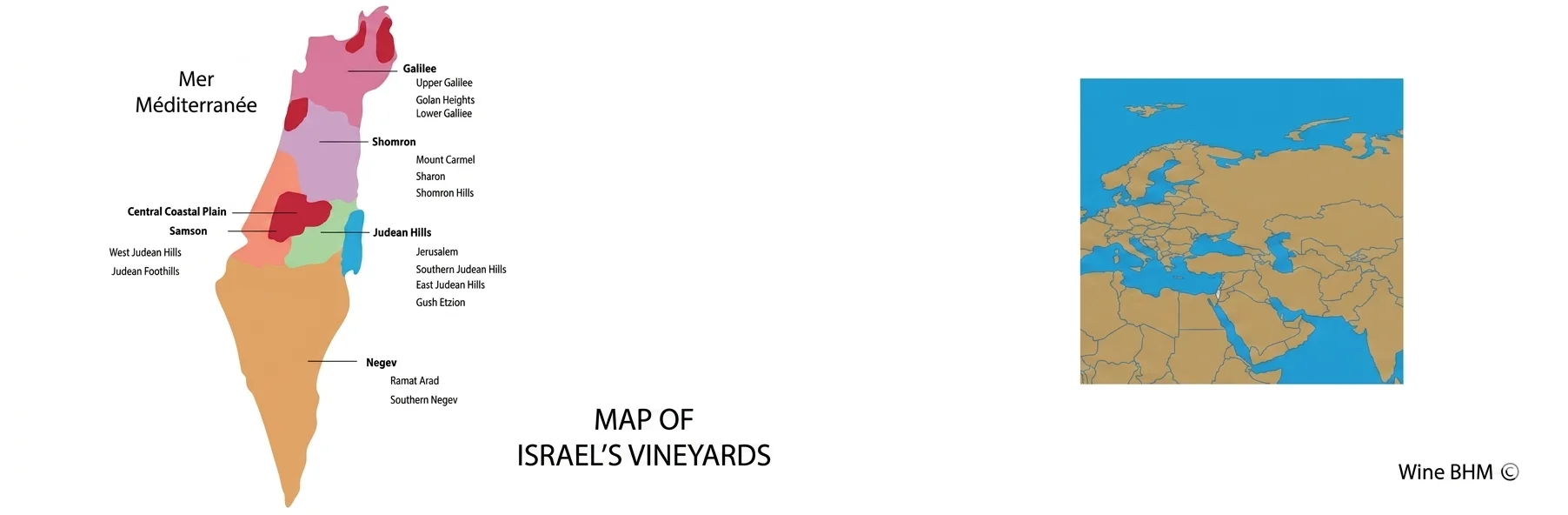
Galilee (Galil): Israel's most prestigious wine region, located in the north of the country. It is divided into Upper Galilee (vineyards up to 900 meters above sea level, bordering Lebanon) and Lower Galilee. Limestone and basalt soils, cool temperatures at higher elevations, significant day-night temperature variations. Exceptional Cabernet Sauvignon, Syrah, and Chardonnay. Leading producers: Dalton, Galil Mountain, Recanati, Adir.
Golan Heights: A volcanic basalt plateau in the northeast of the country, overlooking the Sea of Galilee and reaching an elevation of 1,200 meters. High-altitude continental climate, cold and snowy winters, hot and dry summers. The region that sparked Israel's quality revolution. Yarden, the flagship wine of Golan Heights Winery, paved the way internationally. Unique basalt and volcanic tuff soils.
Judean Hills (Harey Yehuda): A region of limestone hills surrounding Jerusalem, at altitudes ranging from 600 to 900 meters. Cool nights, hot days, fine, stony soils. It was here that Domaine du Castel launched the Israeli boutique wine revolution. Tzora Vineyards, Flam, Clos de Gat, and Yatir produce wines of remarkable finesse and complexity here.
Shomron (Samaria): Israel's largest wine-growing region by area, on the slopes of Mount Carmel and in the coastal plain, around the historic wine-growing towns of Zikhron Ya'akov and Binyamina. Classic Mediterranean climate, with hot, dry summers and mild winters. Carmel Winery, founded by Rothschild, is still based there. Tishbi Winery and Binyamina Winery produce accessible, high-quality wines there.
Shim'shon (Samson): A central region between the Judean Hills and the Tel Aviv coastal plain. Alluvial and limestone soils, temperate Mediterranean climate. A transitional region between mountain vineyards and the plain, producing a wide range of wines from everyday to premium vintages. Barkan Wine Cellars, one of Israel's largest producers, is based here.
Negev: A semi-arid desert region in the south of the country, at an elevation of 600 meters. Drip irrigation, an Israeli invention, makes viticulture possible here. Significant day/night temperature variations, loess soils. Yatir Winery, on the edge of the Yatir Forest at an altitude of 900 meters, produces wines of international renown. It is rapidly expanding thanks to the Negev Wine Consortium, which brings together more than fifty estates.
Israel's flagship grape variety, introduced in the 19th century by Baron de Rothschild from Bordeaux. It expresses itself magnificently in cool, high-altitude regions, Upper Galilee, Golan, Judean Hills, where it develops tannic structure, blackcurrant, cedar, and a complexity reminiscent of great Bordeaux wines. Yarden Cabernet, Yatir Forest, and the Grand Vin de Castel are among the region's finest expressions and have received scores above 90 from Robert Parker and Wine Enthusiast.
Food pairings: Grilled lamb, lamb shawarma, rib eye steak, aged cheeses.
Israel's most promising red grape variety, currently flourishing in the Galilee, the Golan, and the Judean Hills. The best expressions develop aromas of pepper, black olives, violets, and a spicy depth reminiscent of the northern Rhône. Recanati, Clos de Gat, and Galil Mountain produce Syrahs that are increasingly admired internationally.
Food pairings: Middle Eastern grilled meats, lamb tagine, kefta, hard cheeses.
Widely planted throughout Israel, Merlot produces round, fruity, and approachable wines in warmer areas, and vintages of remarkable depth in cooler, higher-altitude regions. It is a key component of Israel's great Bordeaux-style blends, notably at Castel, Flam, and Golan Heights.
Food pairings: Roasted poultry, veal, pasta Bolognese, mild cheeses.
Israel's primary white grape variety, found in all regions. The finest expressions come from cool, high-altitude areas, the Golan, Upper Galilee, the Judean Hills, where it produces elegant, balanced wines with good acidity. Golan Heights Winery, Domaine du Castel, and Recanati offer nationally renowned versions.
Food pairings: Premium fish, John Dory, seafood, hummus with truffle oil.
Rapidly gaining popularity in Israel, particularly in the cool regions of the Golan and Galilee. Lively and aromatic, with notes of citrus and boxwood, and a surprising freshness given the prevailing Mediterranean climate. Flam Blanc, a blend of Sauvignon Blanc and Chardonnay, is one of the country's most admired whites.
Food pairings: Grilled fish, goat cheese, grilled vegetables, fresh salads.
A Mediterranean grape variety currently experiencing a renaissance in Israel, particularly from old bush-trained vines over 40 years old in the Judean Hills. Traditionally a bulk wine grape, its old vines produce wines of striking depth and intensity, with notes of red fruit, garrigue, and earth. Recanati and Sea Horse produce some of the most sought-after versions.
Food pairings: Mediterranean grilled meats, roasted eggplant, dishes with sauce, marinated olives.
Domaine du Castel (Judean Hills), Israel's most legendary estate. Founded by Eli Ben Zaken, a self-taught winemaker trained on the writings of Émile Peynaud, it is the first Israeli estate to have been internationally recognized by Serena Sutcliffe MW and Decanter. Its Grand Vin, a Bordeaux-style blend, and its Blanc du Castel are among the region's most admired wines. The undisputed benchmark of Israeli winemaking.
Golan Heights Winery / Yarden (Golan Heights), The pioneering winery of the Israeli quality revolution, founded in 1983. Its Yarden, Gamla, and Golan lines paved the way for international recognition. Wine Enthusiast's Wine Star Award in 2012, Gran Vinitaly Special Award in 2011. Israel's most award-winning winery in international competitions.
Yatir Winery (Negev), A winery founded by Carmel Winery on the edge of the Yatir Forest, at an elevation of 900 meters in the northern Negev. Its Yatir Forest, a Bordeaux-style blend, received over 90 points from Robert Parker for seven consecutive vintages, a record in Israeli viticulture. A pioneer in high-altitude desert viticulture.
Flam Winery (Judean Hills), A family-owned winery founded by Israel Flam, a former oenologist at Carmel. Its non-kosher red and white wines regularly appear on lists of the best Israeli wines according to Hugh Johnson, Tom Stevenson, and Wine Spectator. Its Cabernet Reserve was selected by La Revue du Vin de France as one of the 100 most remarkable wines in the world.
Recanati Winery (Galilee), One of Israel's most innovative wineries, a pioneer in promoting indigenous Mediterranean grape varieties. Its Carignan wines from old vines, its Syrahs, and its Galilee Sauvignon Blancs are gaining increasing international recognition. An ambassador for the new Mediterranean wave of Israeli wine.
Margalit Winery (Shomron), Founded in 1989 by Dr. Yair Margalit, a chemistry professor and pioneer of boutique wineries in Israel. The country's first boutique winery. Its Cabernet Sauvignons and Bordeaux blends, produced in very limited quantities, are among the most sought-after and collected in Israel.
Galil Mountain Winery (Upper Galilee), A winery founded by Golan Heights Winery in the Upper Galilee, at an altitude of over 700 meters. Its high-altitude vineyards produce wines of remarkable freshness and precision, Cabernet Sauvignon, Syrah, and Merlot among the most balanced in northern Israel.
Tzora Vineyards (Judean Hills), A boutique winery with a distinct terroir-driven style, producing elegant, mineral-driven wines on the limestone terraces of the Judean Hills. Its Shoresh and Misty Hills vintages showcase the unique potential of this mountain terroir and are regularly celebrated by international critics.
Israel is a rapidly growing wine tourism destination, combining millennia of history, spectacular landscapes, and high-quality wine tastings. In the Galilee and the Golan Heights, the wine routes offer breathtaking views of the Sea of Galilee, snow-capped Mount Hermon, and the pine forests of the Upper Galilee. The Ramat Dalton Industrial Park brings together seven wineries in one location, including Dalton, Recanati, and Adir.
In the Judean Hills, just a few kilometers from Jerusalem, Domaine du Castel and Tzora Vineyards offer tours and tastings amidst limestone hills bathed in light. The region lies at the crossroads between some of the world's most historically significant biblical sites and a wine region undergoing a renaissance in quality.
The Negev offers an experience unique in the world: tasting a high-altitude Cabernet Sauvignon in the heart of the desert, at sunset over the craters of Makhtesh Ramon, one of the most spectacular geological landscapes on the planet. The Negev Wine Consortium brings together more than fifty wineries open to wine tourism in this pioneering region.
Charcoal-grilled lamb with a Cabernet Sauvignon from the Golan Heights or a Yatir Forest.
John Dory or sea bass in a herb crust with a Chardonnay from the Galilee or a Blanc du Castel.
Shakshuka with grilled vegetables and a Sauvignon Blanc from the Galilee or a Flam Blanc.
Lamb kefta with Middle Eastern spices paired with a Galilee Syrah or a Recanati Carignan from old vines.
Lebanese mezze and homemade hummus paired with a Galilee Rosé or an aromatic white from the Golan.
Local sheep's milk cheeses (Tzfat, Galilee) paired with a smooth Merlot from the Judean Hills.
Would you like to list your winery or promote it on Wine BHM? Contact us at winebhm.com

Join the selection of producers on the platform.
Join the network*Featured listings are reserved for Pro Premium members, subject to terms and conditions.